Lab Companion EMC Shielded Rapid Temperature Change Chamber: Q8® Web UI Reinvents Intelligent Test Experience
Jun 23, 2026
1. The Final Piece of Laboratory Digital Transformation
Rapid temperature change chambers are one of the most frequently used core devices in R&D and certification processes for automotive electronics, semiconductors, military products and consumer electronics. They are essential for verifying product environmental adaptability and screening structural and process defects. However, most laboratories still rely on traditional offline operation modes, characterized by standalone device control and manual data logging.
This conventional workflow brings obvious limitations. Engineers have to check temperature curves and record test data on-site. Dispersed chamber units cannot be monitored or managed centrally. Test reports require manual sorting and entry, resulting in low efficiency, high human error, poor data traceability and non-standard test procedures. These pain points greatly hinder the standardization and digital upgrading of modern laboratories.
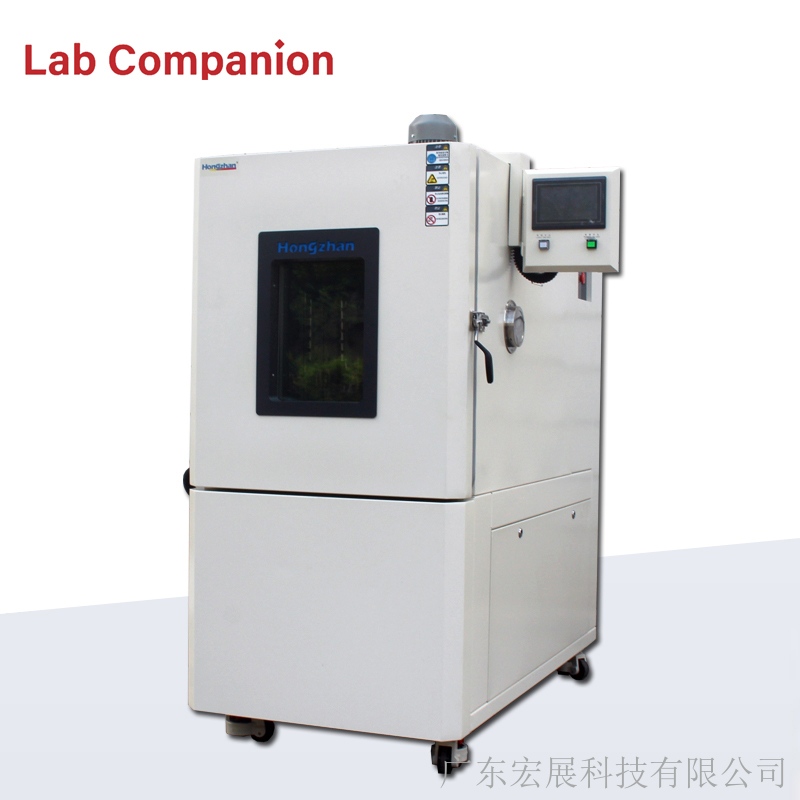
As laboratory informatization and intelligent upgrading accelerate, integrating test equipment into unified digital management platforms has become an industry trend. The Q8® Web User Interface, standardly equipped on Lab Companion Lab Companion EMC shielded rapid temperature change chambers, precisely solves the digital bottlenecks of traditional environmental test equipment. Far beyond a conventional touch display, Q8® transforms temperature chambers into network-enabled, traceable, remotely controllable and AI-powered intelligent terminals. With high-precision control up to 0.01 level and full-process intelligent management, it enables laboratories to shift from labor-dependent operation to data-driven and automatic equipment operation.
This article elaborates on the core advantages and industrial value of the Q8® system from four dimensions: high-precision temperature control, intelligent program management, compliant data traceability and full-scenario remote operation & maintenance.
2. Precision Temperature Control: AI Dual-Algorithm Fusion for Reliable Testing
2.1 Technological Upgrade: From Traditional PID to AI Fuzzy Dual-Algorithm
Temperature accuracy and stability determine the authenticity and repeatability of rapid temperature change tests. Traditional chambers adopt fixed-parameter PID algorithms, which feature poor adaptability. Faced with variable sample heat capacity, ultra-fast temperature variation and ambient interference, conventional controllers commonly suffer from temperature overshoot, response lag and drastic fluctuation, failing to meet stringent high-precision test requirements.
The Q8® intelligent control system adopts a fused AI fuzzy algorithm + dual PID dynamic regulation technology, breaking through the technical limitations of traditional control logic. Mimicking the debugging logic of senior engineers, the system real-time perceives chamber temperature changes, sample heat capacity and external interference, predicts temperature variation trends in advance, and dynamically adjusts cooling and heating output. It realizes predictive temperature regulation and proactive error correction, fundamentally eliminating overshoot, lag and temperature imbalance.
2.2 Three Core Capabilities for Ultimate Temperature Stability
Dynamic Adaptive Control: The AI algorithm captures real-time temperature trajectories, predicts equipment operating status, and optimizes cooling and heating output ratios autonomously. It achieves zero overshoot and zero static error precision control. Combined with the optimized vortex air duct design, the temperature overshoot is controlled within 0.8% for stable and smooth temperature variation.
Intelligent Load Identification & Adaptation: The system automatically identifies the thermal load characteristics of test samples, including high-heat-generating and large-heat-capacity precision components, and matches the optimal control parameters intelligently. Even under complex load conditions, it maintains a standard and stable temperature change rate, preventing sample damage caused by sudden temperature fluctuations and ensuring test compliance.
Full-Range Anti-Interference Compensation: The AI algorithm real-time monitors ambient temperature shifts, power supply fluctuations and equipment operation losses, and activates automatic temperature compensation to offset external errors. It ensures the test data repeatability exceeds 99.5% during long-term continuous operation.
2.3 Industrial-Grade Precision for Versatile High-End Scenarios
Within the ultra-wide temperature range of -70℃ to 150℃, Q8® stably delivers a temperature fluctuation of ≤±0.3℃ and temperature uniformity of ≤±0.5℃. For high-precision scenarios such as semiconductor chips and microelectronic components, the accuracy can be further optimized to ±0.2℃ fluctuation and ±0.4℃ uniformity. It fully meets the strict test standards of consumer electronics, industrial equipment, automotive electronics, military and semiconductor industries.
3. Program Management: Simplified Intelligent Operation Without Complicated Coding
3.1 High-Capacity Programmability for Complex Test Scenarios
The Q8® system supports over 1,200 program segments and a maximum cycle count of 99,999 times, fully adapting to long-duration, multi-stage and high-cycle environmental stress screening. Equipped with a visual graphical editor with drag-and-drop operation, users can freely build customized test procedures including heating, soaking, cooling and cyclic operation, and generate arbitrary temperature-time curves such as linear temperature rise, nonlinear thermal shock, constant temperature and gradient variation.
Compatible with both linear and nonlinear rapid temperature change modes, the system allows flexible customization of temperature change rates, temperature ranges, cycle times and soaking duration. It covers mainstream test applications including conventional temperature cycling, highly accelerated life testing (HALT), extended environmental stress screening (ESS) and high-low temperature shock testing.
3.2 Preloaded Global Standards for One-Click Compliant Testing
To solve the inefficiency and parameter errors caused by manual programming for diverse industrial standards, the Q8® system is preloaded with mainstream global rapid temperature change test templates. Via the 10.4-inch high-definition color touchscreen, users can select the target standard with one click, and the system will automatically load all compliant parameters including temperature range, temperature change rate, cycle times and dwell time, eliminating manual programming and greatly shortening test preparation time.
The built-in standard library covers worldwide authoritative specifications: military standards including GJB 1032 and MIL-STD-2164, automotive electronic standards including full-grade AEC-Q100 (Grade 0~3), and general international standards including GB/T 2423.22 and IEC 60068-2-14, supporting one-stop compliant testing for multiple industries.
3.3 Template Storage & Power-Off Resume for Unattended Operation
The system stores more than 100 sets of commonly used process programs as reusable templates for one-click invocation, greatly improving operational efficiency. It supports timed and delayed startup, enabling 72-hour continuous unattended operation with real-time AI monitoring of equipment status and test progress.
Equipped with a power-off memory function, the system automatically resumes unfinished tests after power recovery without program reset or data loss. It effectively avoids test interruption, sample scrapping and repeated testing, ensuring the continuity and integrity of long-cycle experiments.
4. Data Traceability: Full-Process Recording for CNAS Compliance & Audit
4.1 Second-Level Automatic Data Collection to Build Closed-Loop Data Chains
During the entire test process, the Q8® system automatically collects full-dimensional data including temperature, humidity, equipment operating status, alarm records and operation logs at a minimum 1-second sampling interval, completely replacing manual logging. Data can be saved locally, exported via USB, or uploaded in real time to FTP servers and NAS cloud storage for permanent backup.
The system’s built-in high-capacity storage supports over 100,000 test data records and up to 600 days of historical data retention, meeting long-term traceability, quality review and process optimization demands of enterprises and third-party laboratories.
4.2 Multi-Format Export & One-Click Standard Report Generation
Q8® supports multiple data output formats including CSV raw data, PDF visual reports with temperature curves and Excel structured tables. Users can customize report templates in accordance with CNAS accreditation specifications, enterprise quality management systems and third-party certification requirements. Standardized test reports with complete curves, operation logs and parameter details can be generated with one click, avoiding low efficiency and non-standard issues of manual report making.
All test curves, original data, alarm records and operation tracks are fully retained and traceable, forming a complete closed-loop data system that fully adapts to laboratory quality audits, third-party certification and product quality review scenarios.
4.3 Hierarchical Permission Control for High-Level Compliance Requirements
For CNAS-certified laboratories, precision testing institutions and enterprises with strict compliance demands, the Q8® system provides a complete security and audit tracking system that meets FDA 21 CFR Part 11 requirements. It adopts three-level hierarchical permission management: Administrators have full access to parameter configuration and permission management; Engineers can edit test programs and export data; Operators are only authorized to view status and start/stop tests, ensuring clear authority division and avoiding misoperation risks.
All parameter modifications, program edits, equipment operations and abnormal alarms are fully logged with audit trails. Every operation is traceable and verifiable, ensuring the authenticity, integrity and compliance of test data.
5. Remote Operation & Maintenance: Borderless Intelligent Equipment Management
5.1 Cross-Terminal Web Access for Anytime Remote Monitoring
Built on a pure Web architecture, the Q8® system requires no client software installation or complicated configuration. Users can log in to the control interface via any browser on mobile phones, tablets or computers within the local area network by simply entering the device IP address. It supports real-time monitoring of temperature, humidity, operating status and test progress, remote parameter modification, program start/stop and mode switching, as well as zoomable historical curve viewing and abnormal point marking. It also supports alarm notifications via email and SNMP Trap for instant fault awareness.
For enterprises with multiple factories and distributed laboratories, the system supports remote access via VPN and port mapping, enabling managers to monitor and control equipment status anytime and anywhere without on-site patrols.
5.2 Centralized Multi-Device Management for Efficient Batch Operation
The Q8® centralized management dashboard integrates multiple Lab Companion environmental test equipment into a unified visual interface. It displays the real-time status (running/standby/alarm), current temperature, remaining test time and program progress of all connected chambers at a glance.
Managers can overview the operating status of all devices with one click and access detailed control pages for individual units, eliminating repeated on-site inspections. It significantly reduces multi-device operation and maintenance costs, improves overall laboratory efficiency, and adapts to large-scale and standardized laboratory management.
5.3 Intelligent Fault Diagnosis for Predictive Maintenance
Equipped with an all-round self-inspection and health monitoring module, the Q8® system 24/7 monitors the operating parameters of core components including compressors, temperature sensors, fans and heating units. It adopts AI algorithms to analyze equipment health trends and predict potential faults in advance. A multi-level early warning mechanism triggers reminders via screen pop-ups, message pushes and cloud alarms for risks such as compressor overload and sensor abnormality, with clear fault causes, locations and solutions provided.
Technical personnel can remotely troubleshoot faults, adjust operating parameters and upgrade system firmware, greatly shortening response and repair time. The system upgrades traditional passive fault repair to active predictive maintenance, effectively reducing failure rates and downtime, and extending equipment service life.
6. Value Upgrade: From Hardware Device to Intelligent Laboratory Infrastructure
As the intelligent core of Lab Companion Lab Companion EMC shielded rapid temperature change chambers, the Q8® Web UI has gone beyond the definition of a traditional controller. It serves as an all-in-one intelligent brain integrating AI high-precision control, intelligent program scheduling, compliant data traceability and remote intelligent O&M.
The AI dual-algorithm fusion guarantees ultra-high test precision, preloaded global standards simplify test deployment, full-process data collection ensures audit-ready traceability, and cross-terminal remote management realizes efficient predictive maintenance. Q8® upgrades traditional temperature test chambers from simple hardware execution tools to data-driven, intelligently operated and fully controllable modern intelligent test terminals.
For laboratories undergoing digital transformation, the Q8® system delivers far more than operational efficiency improvement — it provides a complete intelligent test solution. It connects the full data workflow of equipment operation, test execution, data archiving and equipment maintenance, realizing standardized test procedures, compliant data management and intelligent equipment operation. Helping enterprises reduce costs, standardize quality control and boost innovation efficiency, Q8® has become the core intelligent infrastructure for modern laboratory digital upgrading.
ĐỌC THÊM




 Nhận báo giá


 Mạng IPv6 được hỗ trợ